Sunday, 27 April 2014

Divergent (2014) : A Factional Dystopia

Veronica Roth's Divergent is the first instalment in a trilogy which depicts a post-apocalyptic Chicago, where society has been divided into five factions, determined by one's predominant personality. The factions are Abnegation, Amity, Candor, Dauntless and Erudite. Abnegation value selflessness above all else, and forget oneself for the sake of others. Amity is dedicated to peacefulness, kindness, forgiveness, trust, self-sufficiency and neutrality. Candor was value honest above all else. Dauntless was the faction dedicated to courage, bravery, and fearlessness. Erudite is the faction which values knowledge, intelligence, curiosity and astuteness above all else. Members of this society undertake an aptitude test during their youth and are then invited to choose a faction which they will then dedicate their lives to.

The plot of this narrative follows Beatrice (Tris) Prior, played by Shailene Woodley, as she undertakes this factional practice. However, straying from convention, Tris undertakes the aptitude test and her results are inconclusive: rather than singularly pointing her towards one faction, she instead, shows an aptitude for three factions: abnegation, erudite and dauntless, which means that she is in fact "Divergent" - a word that is almost as taboo as a whispered "Macbeth" in the theatre. During the choosing ceremony, Tris opts to transfer from her family faction and join the crew of Dauntless initiates, who establish the protection and security part of the society. 

The majority of the film follows Tris' journey to become a Dauntless initiate and then the induction process as she attempts to become a true member of Dauntless rather than essentially "fail out" and become a member of the factionless. The film and novel culminate in a scheme by the Erudite to enact utilise the Dauntless to usurp the governance of the Abnegation.

The film maintains the token elements expected within these young adult post-apocalytpic narratives such as an attractive male lead, a suitably dour antagonist, a hero one can support as they struggle against adversity, and crucially, a climatic difference from our current society.

The general plot of the novel and film is intriguing. However, when compared to its leading competition: The Hunger Games trilogy: it does not have the same impact or poignancy. As a cinematic feature, it is an enjoyable and easy watch. The dystopia Roth has constructed in interesting, but, the overall significance of the piece is somewhat diminished when compared to The Hunger Games series. 

There is a sense in which the narrative series and film have the potential to be as touching and impressive as The Hunger Games, but, that Roth hasn't engaged enough with these factions and with her society to ensure its full meaning. Overall, I would recommend people watch this film as it is definitely an enjoyable watch, just try not to compare it to The Hunger Games, because it's not really in in the same league.

Sunday, 2 March 2014

Fall 2014 Ready-to-Wear Collection: Martin Grant Runway Show: 1st March 2014


Australian-born Martin Grant showcased his Fall collection on the 1st of March. He launched his first ready-to-wear line in 1982 and was soon recognised as a budding fashion talent. He was awarded the Cointreau Young Designer Award in Sydney in 1988. Martin Grant deliberately avoids the fashion system and chooses to present his collections to relatively small selected audiences, which gradually assembles a loyal clientele. 

His pieces tend to focus upon bespoke tailoring, focus upon the small details and simplicity of lines and form. His collection demonstrates elegances in the manner of timeless silhouettes, understated charm and acknowledgement of the sculpted form. He adheres to the shape of the body to emphasise feminine curves. The clothing he has created tends to be functional, with sharp, geometric and a focus upon structure, yet there is always a feminine delicacy too. Fundamentally, he operates a neutral colour palette and tends to influence his colour scheme in direct correlation to the seasonal directive. 

Martin Grant's Autumn collection features clothing with block colouring or with geometric print. The colour palette is attuned to the autumnal season with the majority of his clothing featuring the grey, navy, black and white which is reminiscent of the winter season.  The sailor coats, cocktail dresses and gala gowns represent the clothing which is typical to his designer ethos and objective.

The constructions created by Martin Grant successfully carry the beauty and elegance of which he has become renowned. The focus upon tailoring and the demure colour scheme evoke the traditional autumnal themed clothing collection. 

However, the relatively conventional tailored pieces of his collection are punctuated by the introduction of the fuchsia dress and skirt along with the gold utilised in his patterned dresses and skirts. The input of these colours help to breathe life back into the relatively demure and chaste collection.

Through the addition of the fuchsia pink, gold and a floor length gown with a rather provocative split, Martin Grant's collection adds a bit of allure to his typical style and grace.  

Fundamentally, Martin Grant has created a beautiful collection: his clothing is stunning and stylish, and it is filled with items which truly are "Ready-to-Wear" for the Autumn period. Grant truly is one to watch for the mature working woman: his pieces would be a perfect addition to any woman's working wardrobe, or even for networking after-work drinks.  Some may believe that he is fulfilling the staple Fall collection desires, however, they fulfil those desires with exceptional sophistication and charm. His collection presents the classics but with a classic and archetypal structured refinement which has come to be expected from his designs. 

Fall 2014 Ready-to-Wear Collection: Olympia Le-Tan: 1st March 2014.


Olympia Le-Tan is a self-taught fashion designer. She began her career at the Chanel design studio with Karl Lagerfeld then went on to Balmain where she worked closely with Gilles Dufour who then created his own brand with Olympia by his side.

However, in 2009 she decided to branch out on her own and created her eponymous accessories label, which effectively combined her passions for embroidery and literature. She amalgamated these obsessions to create one of a kind handbags and minaudières. 

Her ideas became renowned across the fashion world and she immediately became popular. The brand's signature book-clutch has been bought by a number of celebrities such as Tilda Swinton and Natalie Portman, along with numerous others.

In March 2012, she expanded her brand and devised her "Ready to Wear" collection where she creatively altered the classics to create something new. 

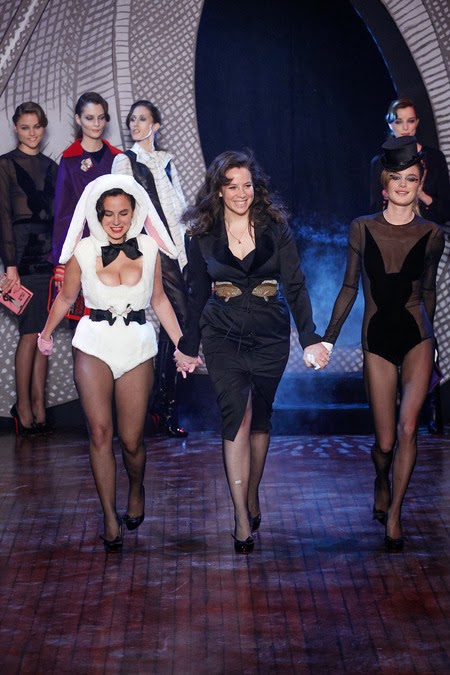
For her Fall 2014 Ready-to-Wear Collection which she showcased in Paris on the 1st of March 2014. The show was fun and appears to combine elements of the circus with that of magic. Her pieces exhibit whimsical fun designs which are more daring than the sailor-housewife clothing of her incumbent collection.

The models sported outfits which were reminiscent of those worn within Alice in Wonderland especially the Queen of Hearts and her soldiers. The pieces all carry images of the playboy bunny, playing cards or hearts, which effectively revives the Alice in Wonderland story, however, she attempts to add a sensual edge to these pieces through the sheer bustier and the dependence on presenting the feminine hourglass shape. 

However, Le-Tan has not completely altered from her quintessential sweet and youthful charm. She has created one ensemble which clearly demonstrates this: a baby pink angora cardigan which is teamed with a mini-crini). There is a definite Pink Ladies vibe about her ensemble, which is highlighted through the 50's hairstyle which the model wears. 


Le-Tan hasn't moved completely away from the Lolita-isms she tends to favor (see the angora cardigan and mini-crini), and the way she embraced the Playboy Bunny won't appeal to every woman. But elsewhere the workmanship looked finer here than it has in the past. There was a new sophistication to a puff-sleeved, "abracadabra"-embroidered blouse worn with a ruched-waist, below-the-knee skirt. If you want to stack the deck in your favor for a fun night on the town, we suggest her velvet tuxedo and embroidered Queen of Hearts bustier.

Her new collection is sophisticated with a fun and daring edge: it is the perfect combination of sassy and sweet. The show demonstrated that she is growing as a designer and personally, I cannot wait to see what else she has in store for us in the future.

Saturday, 1 March 2014

A New York Winter's Tale: It's Like a Movie Hangover.

Sadly disappointed with this. The trailer provided expectations of a story which definitely paled by comparison to the reality of the film. Based upon the novel Winter's Tale written by Mark Helprin, I was definitely underwhelmed following this cinematic production. 

It is difficult to capture the concept and setting of the film because it seems as if that was an insignificant detail for the filmmakers. There is a clear Edwardian-style era however, with the invocation of devils and spirits, or whatever they were, it is really difficult to grasp what the hell is actually going on. The mishmash of miracles, the devil and constant reference to destiny juxtapose their Edwardian setting uncomfortably and instead present an ulterior reality which in fact seems entirely implausible. 

Usually a fan of Colin Farrell, I was really disappointed by his performance in A New York Winter's Tale. Though to be perfectly honest, that may have had very little to do with his acting as I was much more preoccupied by the abysmal hairstyle which he assumed throughout. Distracted by this hideous styling choice I found it difficult to become fully invested in his characterisation and the narrative plot. 

Protagonist Colin Farrell plays Peter Lake, a handsome thief who was abandoned as a baby in New York by his parents in a hollowed out model sail boat, which is of course 100% plausible. He grows up in and out of foster homes and on the street, eventually becoming a thief (just as every parent wishes for their child). 

However, he does seem to come by exceptionally good luck when he breaks into the home of Beverly Penn, a beautiful young heiress from London now living, or more appropriately, dying in New York. She is afflicted with TB and sleeps outside in a tent construction in order to keep her fever at a manageable temperature. Downton's Jessica Brown Findlay plays the quintessentially British heiress Beverly, once again demonstrating the rich falling for the poor scenario, except this time she does not fall for the family driver, but someone attempting to burgle her family home. 

Other guest stars include Russell Crowe as the overweight, devouring devil-type antagonist Pearly Soames and Will Smith as the rather comical yet unnerving Lucifer. With Russell Crowe in particular, his Irish accent has been taken straight out of the "How to Speak like a Wee Little Leprechaun" book. It is an accent that is so badly executed that it rivals Anne Hathaway's truly horrific attempt at a Yorkshire accent in One Day.  Even with the addition of these famous actors, this production lacks any potential for resuscitation  Having not read the books, I cannot categorically state that the plot had cinematic potential, however, having watched the film, I can definitely suggest that the performance was so lifeless that I ended up wishing I could have the time wasted watching the performance repaid.

So overall, I do not recommend this movie...well unless you enjoy laughing at abysmally bad attempts at accents or a complete lack of coherent plot construction. Do not waste your time or money with this film. It would be more interesting to watch paint dry. 

The Book Thief by Markus Zusak

This book is now atop my "Everyone Must Read" list, in fact it has gotten so bad that I am pestering friends and family to ensure that they have read the book before seeing the movie which was released on the 26th February.

When you read the first page and are encountered with the fact that the narrator of the book is Death, you are left stunned. From that moment, I was entranced...a book narrated by death is something that I had never considered being sorely lacking in Pratchett book history knowledge. But when the subject of the book is the Second World War, and particularly the Nazi agenda in Molching, Death is probably the only unbiased angle from which to approach the war. By utilising Death, Zusak can effectively dispel with an ideologically biased stance and to a degree allow the reader (whom is hopefully against the racial discrimination of the Nazi agenda) to simply comprehend the difficulty of people who were on the German side. Additionally, the last line of the text is something which resonates with the text's readership and makes an enormous impact upon them, challenging their preconceptions: 'I am haunted by humans.'

Throughout the duration of the novel, the reader is captured by the sense in which life is interconnected and the huge ripple effect which one human life can attain. The themes within the novel concern love and loss, particularly in the context of wartime scenarios. 

The book culminates in a rather tragic ending, and despite being forewarned by the narrator of the three instances of death due, the impact upon the reader is still heart-breaking. The narrative ensures that the reader feels emotionally connected to the characters and therefore the fatal ends to some of them feels like a personal loss. 

The main narrative concerns the story of the German Hubermann family which is Hans and Rosa, with their wartime adopted daughter Liesel Meminger who hide a Jew named Max Vandenburg during the course of the Second World War. The plot predominantly concerns the actions and events of Liesel Meminger as Death is drawn to her on various occasions. 

Outside of the central plot, Liesel Meminger's life is altered by various other characters, her best friend Rudy Steiner; the mayor's wife Ilsa Hermann and Frau Holtzapfel, whom originally begins as Rosa's arch-rival but steadily becomes emblematic of wartime disenchantment. 

This story literalises the writing over of German wartime recollection in a very new way. Just as Max Vandenburg gives Liesel the gift of the whitewashed copy of Mein Kampf in order to write her own story, Zusak effectively writes over the reader's preconceptions of the German during the Second World War to create a unique story which emotionally moves its audience. Definitely a must-read for all. 

Wednesday, 12 February 2014

August: Osage County - A New Yardstick Against Which to Measure the Dysfunctional Family.

August: Osage Country is based upon the perverse comedy of Tracy Letts' Pulitzer Prize-winning play with the same name. The play and film are set during the wake period of the Weston family patriarch Beverly Weston (Sam Shepard) who has committed suicide and thus has brought all of the branches of his family back to their roots in Osage County. 


The Weston family are shown throughout the cinematic performance to be extremely disconnected and respectively have little drive or desire to connect with one another, except within circumstances out of their control, such as the death of Beverly Weston.  The unusual social dynamics between these family members culminate in the bittersweet post-funeral lunch scene which effectively showboats the total collapse of relations between this Oklahoma family. Violet Weston (Meryl Streep), the drug-addicted, malevolent matriarch resents each of her family members in various manners and utilises this luncheon to expose familial guises in her unhinged moment of "truth-telling".

Around the post-funeral lunch table seat Violet Weston, the three Weston daughters; Barb (Julia Roberts), Karen (Juliette Lewis) and Ivy (Julianne Nicholson), Barb's estranged husband Bill Fordham (Ewan McGregor) and their daughter (Abigail Breslin), Karen's fiancé Steve Heidebrecht (Dermot Mulroney), Violet's sister Mattie Fae Aiken (Margo Martindale, her husband Charles Aiken (Chris Cooper) and their child (Benedict Cumberbatch); as well as the recently hired Native American caretaker/maid Johanna Monevata (Misty Upham). 

Violet arriving late to the table is seated at its head and demands that the men wear their dinner jackets despite the sweltering heat out of respect for the formality of the occasion. Once they have obeyed her command with childish embarrassment upon their faces, she delivers her poisonous wrath to each of her family members. The viewing audience is left in bewildered silence, unable to recover from the perniciousness of her savage tongue. Struggling with the effects of oral cancer, she manifests the natural toxicity of this cancerous treatment in her bloodthirsty verbal annihilation of her family.

The film unveils a number of important familial secrets and unapologetically portrays the raw family resentments and sentiments culminating in the appearance of taboo activities such as paedophilia, incest, adultery and addiction. August: Osage County is the dysfunctional family reunion from hell, not only due to the ailing matriarch and her viciousness but also due to the emergence of truths which have been quelled for many years. 

This cinematic depiction which its typical American setting delves into the dysfunctional family dynamic in a new way and effectively interrogates the complex intricacies at play in the inter-workings of the typical family unit. The film is captivating from beginning to end and hosts a feast of emotions. Definitely recommend, if only to be grateful that your mother is not half so actively evil as Violet Weston, or in fact her often referred to sadistic mother. 

The Butler: Tracking the African-American Civil Rights in a New Way.

  • The Butler (2013) loosely depicts the life events of Eugene Allen, who served as a butler at the White House for 34 years, between 1952 and 1986. This American history drama captures the living history of Cecil Gaines, who served as a butler under eight different presidents. The narrative focuses upon the difficult race relations between the whites and the blacks in the South, and this focal point is heightened through the fact that Cecil Gaines' eldest son Louis, becomes a political radical which provides a great amount of tension with the Gaines household.

    The film begins in with Cecil as a boy on a cotton plantation in Georgia where he witnesses his mother be raped and his father get shot. These poignant moments invoke the important thematic silence of African Americans in the face of their white American "owners" or "superiors". It is this topical silence which effectually infects the father-son relationship between Cecil and Louis Gaines, who adopts the typical Black Panther identity and ethos which favours violent retaliation to racial segregation and discrimination. 

    Cecil Gaines, played by Forest Whitaker, and his wife, Gloria Gaines, played by Oprah Winfrey, illustrate a typical marriage with both love and hardships; and at one moment the archetypal soap opera extra-marital affair with the neighbour. They both act with proficiency and effectively convey emotion to their viewership. Alongside these two leading actors, the film is studded with various stars all of whom contribute to ensure that the production makes a large impact. 


    Whilst Louis Gaines is depicted throughout the cinematic enterprise as an active agent within the civil rights campaign, Cecil Gaines' refusal to become actively involved with the civil rights campaign is both respectable and infuriating. Gaines continues with his "keep quiet" mantra which he discovered during his early days as a humble hotel butler.

    Forest Whitaker is dramatically enriching within his portrayal of The Butler, particularly in light of the background of racial tensions and battle for civil rights. The film appropriately concludes rather too neatly on the precipice of a meeting between Cecil Gaines and the recently inaugurated black president, Barack Obama.   

    This cinematic production is a filled to the brim with various famous actors which adds to the dynamic of the film. However, with the coherence of Forest Whittaker and Oprah Winfrey throughout admirably making a powerful and understated impact. Overall, the film is thoroughly enjoyable and enriching in its suppressed emotional nature which pervades the entire performance.